The short answer
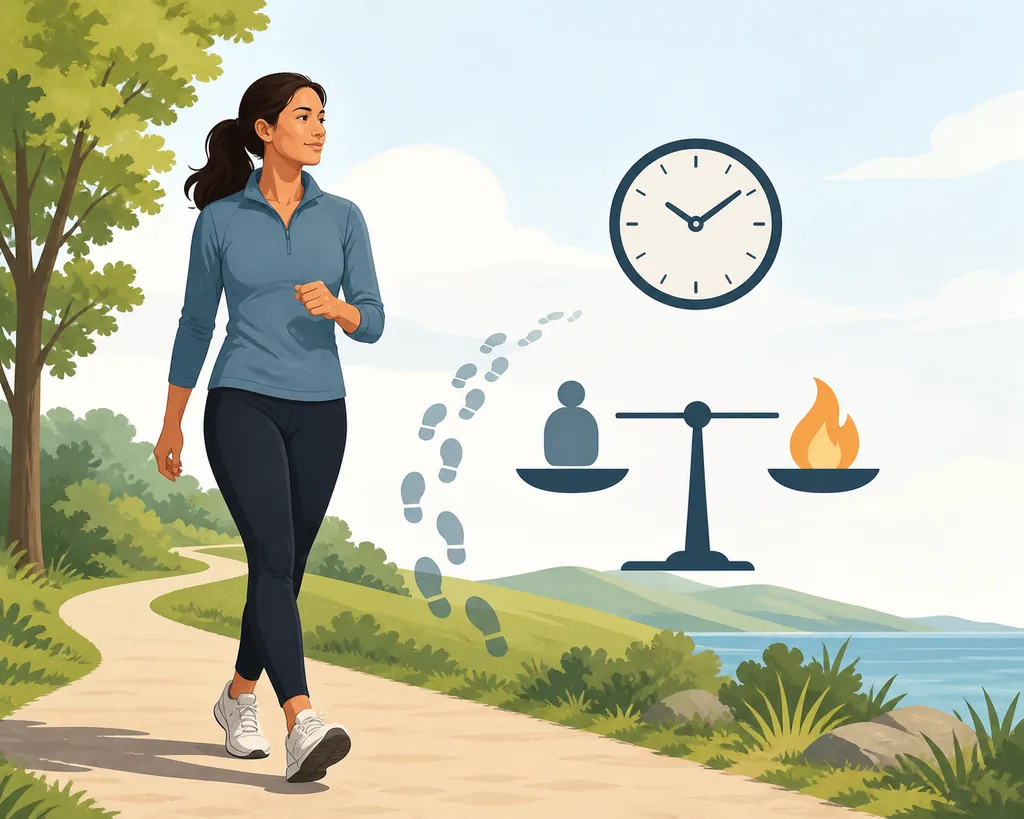
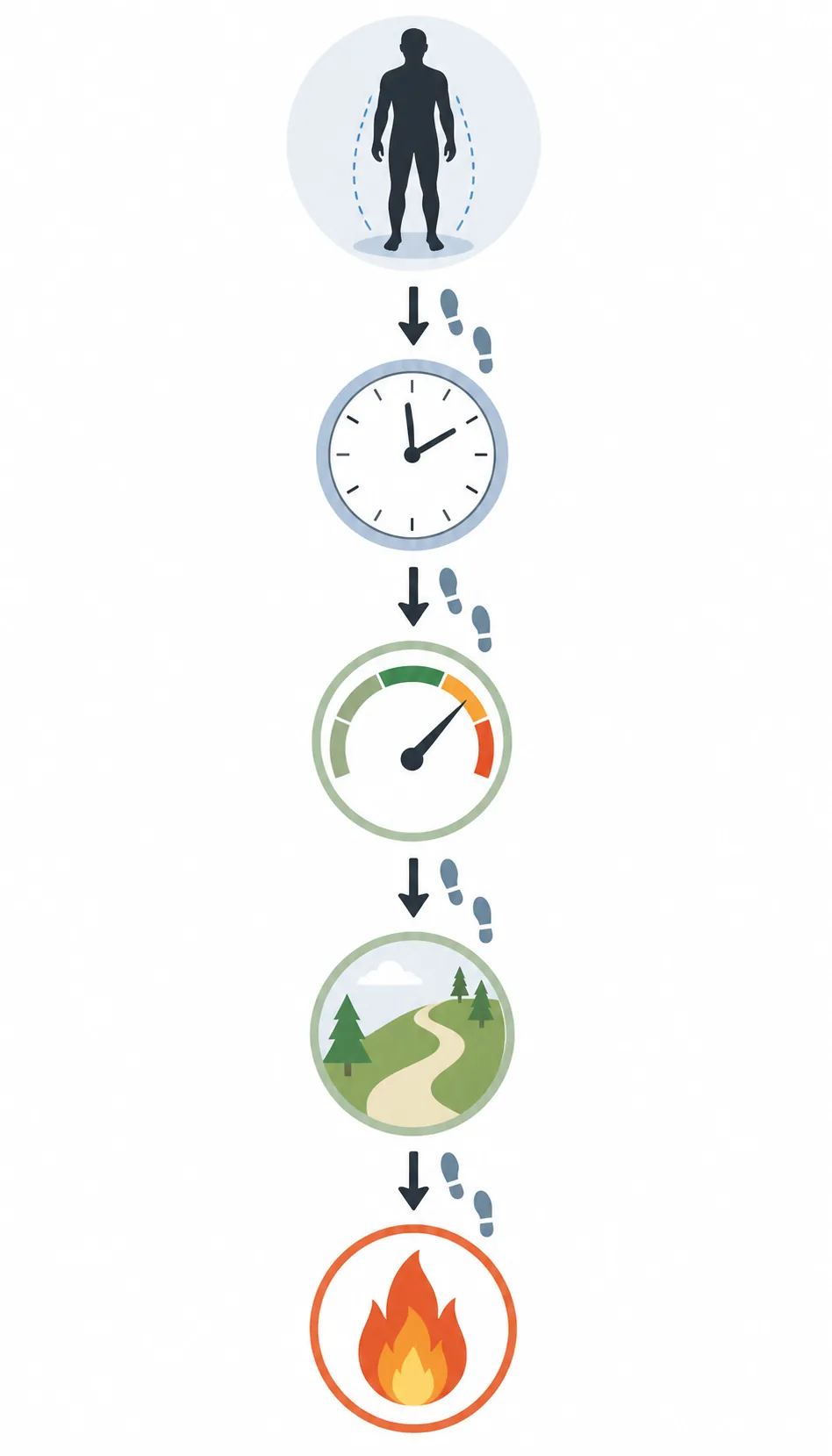
How many calories does walking burn? It depends mainly on body weight, time, pace, incline, and terrain. A longer or faster walk usually uses more energy, and a heavier body usually uses more energy for the same route. That is why two people can take the same number of steps and still receive different calorie estimates.
For a practical starting point, think in ranges rather than a single reward number. A moderate 30-minute walk may be roughly around 100 to 220 calories for many adults, but the useful range changes with body size and pace. If you need a more tailored estimate, enter your weight, walking time, speed, incline, and surface in the existing walking calorie calculator.
What walking calories actually mean
A walking calorie estimate is a model of the energy used during a session. It is not a direct measurement of the calories released by your body, and it is not automatically the number of calories you should eat back. The estimate can still be useful when it helps you compare repeatable walks, choose a realistic routine, or understand why a hill feels harder than a flat route.
The word estimate matters because walking is not one fixed activity. A gentle stroll, a brisk outdoor walk, a treadmill incline session, and an uneven trail have different energy costs. Even within one session, pauses, handrail support, wind, temperature, stride length, and fatigue can change the result. A transparent calculator makes those assumptions visible so you can interpret the output instead of treating it as laboratory data.
For weight management, walking calories belong inside the bigger picture of maintenance calories, food intake, sleep, recovery, and the trend in body weight. A walk can be valuable even when the calorie number is modest: regular movement, mood, fitness, and adherence often matter more than chasing the largest displayed burn.
- Body weight changes the energy cost of moving the same distance.
- Time and pace describe how much work is done and how long it continues.
- Incline and uneven terrain add work that a flat-step count cannot show.
- A repeated range is more useful than one unusually high device estimate.
How a walking calorie estimate is calculated
Many exercise calculators use a MET-based approach. A MET is a practical way to describe the energy cost of an activity compared with resting. The walking intensity is estimated from pace, grade, or activity category, then combined with body weight and duration. The formula is useful because it shows why changing one input changes the result; it is not a promise that every person burns the same amount.
A simplified version is shown below. Different calculators may use different walking equations, activity tables, terrain adjustments, or rounding rules. That is why two credible tools can disagree without either one being broken.
For a fair comparison, keep the unit system, walking surface, duration, and pace consistent. If you compare a watch with a calculator, remember that the watch may use heart rate and motion data while the calculator uses explicit assumptions.
Calories ≈ MET × 3.5 × weight_kg ÷ 200 × minutesMET = estimated intensity from pace, grade, or activity categoryHigher weight + longer time + faster pace usually raises the estimateIncline and uneven terrain can add energy cost beyond flat walking| Variable | What it means | Example |
|---|---|---|
| Body weight | The mass moved during the walk. | 60, 80, or 100 kg |
| Time | How long the walking session lasts. | 30 or 60 minutes |
| Pace and grade | The estimated intensity of the walk. | Moderate flat walk or brisk incline walk |
| Surface | A practical adjustment for a treadmill, pavement, hill, or uneven trail. | Flat, incline, or mixed terrain |
The formula is a planning model, not a metabolic test. Use it for comparisons and trend-aware decisions, not for medical dosing or a guaranteed food-credit number.
How many calories does 30 minutes of walking burn?
The table below gives broad planning ranges for a moderate flat walk. It is intentionally presented as a range because pace, body composition, route, and walking efficiency vary. A faster walk or a hill can move the result higher; an easy pace with pauses can move it lower.
If your question is how many calories you burn walking for a full hour, the simplest first approximation is roughly twice the 30-minute estimate when pace and conditions remain similar. In real life, fatigue, stops, and changes in route mean the result will not be perfectly linear.
Use the examples as a sanity check, then use the calculator with your own inputs. The goal is not to find a flattering number; it is to choose an estimate that is consistent enough to compare one week of walking with the next.
| Body weight | 30 minutes | 60 minutes |
|---|---|---|
| 60 kg / 132 lb | 95–125 kcal | 190–250 kcal |
| 80 kg / 176 lb | 125–165 kcal | 250–330 kcal |
| 100 kg / 220 lb | 160–205 kcal | 320–410 kcal |
- Choose the row closest to your current body weight.
- Start with the 30-minute column for a lunch walk or short cardio session.
- Use the 60-minute column only when the pace and route are broadly similar.
- Move the range upward for brisk pace or incline and downward for easy pace, pauses, or handrail support.
- Compare the estimate with recovery, hunger, and your overall weekly routine rather than treating it as exact credit.
A 30-minute walking estimate is most useful as a repeatable reference point. It answers the practical question without pretending that a calorie model can observe every detail of your body or route.
How pace, incline, and terrain change walking burn
Pace matters because a faster walk generally requires more energy per minute. The change is not identical for every person, and running is not simply a faster version of walking, but a brisk walk can produce a noticeably different estimate from a relaxed stroll. Choose the setting that matches the movement you can actually repeat.
Incline adds vertical work. On a treadmill, a small grade can make a comfortable speed feel much harder. Outdoors, hills, stairs, wind, and uneven ground can have the same practical effect. Do not use a steep setting to chase a number if your form breaks down or you need to hold the rails.
The table is a decision aid, not a prescription. Use the lowest-intensity assumption that matches your normal session, then adjust from experience rather than selecting the hardest option because it looks more rewarding.
| Walking style | What usually changes | Best use |
|---|---|---|
| Easy flat walk | Lower energy cost per minute | Daily movement, recovery, and a repeatable baseline |
| Brisk flat walk | More work per minute at a faster pace | Steady cardio without running speed |
| Incline walk | Higher cost because grade adds vertical work | Shorter, harder sessions when form and recovery stay good |
| Uneven trail | Small practical adjustment for mixed surfaces and changes of direction | Outdoor routes that do not behave like a flat track |
Steps, watches, and the walking calorie calculator
Step count is convenient, but it does not describe the whole session. Ten thousand short, slow steps are not the same as ten thousand longer, brisk steps, and a step counter may include normal movement that is not a continuous walk. If you want to answer how many calories walking burns, combine steps with active walking time, pace, body weight, and terrain.
A wearable can be helpful when you use it consistently. However, wrist movement, heart-rate error, missing grade data, device assumptions, and pauses can affect the displayed number. The best comparison is usually the trend from the same device and routine, not a one-day contest between two tools.
For a transparent estimate, open the walking calorie calculator and enter the variables it actually uses. Then link the result to your maintenance calories or weight trend. That keeps the arithmetic on the tool page and the interpretation on this guide.
Use active walking time
Separate a continuous walk from a full-day step total when you want to compare exercise sessions.
Keep conditions consistent
Repeat a similar pace, surface, and duration before deciding that one estimate is higher or lower.
Treat the result as a range
A consistent estimate is useful for planning even when the true number cannot be observed directly.
Check the bigger trend
For weight goals, consider maintenance calories, food intake, recovery, and weekly weight averages together.
Common mistakes when estimating calories burned walking
The most common mistake is assuming that one exact number applies to every walk. Another is counting the same activity twice: a maintenance estimate may already include normal movement, while a person may then add the full exercise estimate again. That does not make walking unhelpful; it only means the arithmetic needs a clear boundary.
It is also easy to overread 10,000 steps, a treadmill display, or a smartwatch result. These tools are useful when their assumptions are understood, but none can see every portion of a meal, every pause, every change in terrain, or every difference in walking efficiency.
- Treating 10,000 steps as one universal calorie value.
- Choosing a steep incline while holding the rails and assuming the full estimate still applies.
- Adding exercise calories twice when the daily maintenance estimate already includes activity.
- Changing food intake after one high or low device reading.
- Using the estimate for medical nutrition decisions that require individualized guidance.
Limits, safety, and when a generic estimate is not enough
This guide is for general adult planning. A walking calorie estimate cannot diagnose a health problem, measure your exact energy expenditure, or tell you what to eat for every medical situation. Pregnancy, breastfeeding, adolescence, eating-disorder recovery, diabetes management, medication changes, and other conditions may require individualized advice.
Keep walking comfortable enough to maintain stable form and normal breathing for the session you chose. If pain, dizziness, chest symptoms, unusual shortness of breath, or persistent fatigue appears, stop and seek appropriate medical help. The calorie number is never more important than safety.
Walking calories FAQ
Method notes and references
These references support the general exercise-intensity and safety context. They do not make any single walking route estimate exact.
- Compendium of Physical Activities — for activity-intensity and MET background.
- American College of Sports Medicine — for exercise testing and metabolic-equation context.
- Harvard Health Publishing: Calories burned in 30 minutes — for practical activity-calorie comparison context.
- CDC: Benefits of Physical Activity — for the broader health context of regular physical activity.
Ready to estimate your own walking session?
Use the walking calculator for the arithmetic, then return to this guide when you need to interpret the range or compare it with your routine.